Kazakhstan has received the first shipment of equipment for its flagship petrochemical complex, marking a decisive step from exporting raw materials to producing high-value polymers. The new Silleno plant is expected to reshape trade flows across Central Asia, intensify competition with global petrochemical producers, and create new opportunities for regional industrial cooperation.
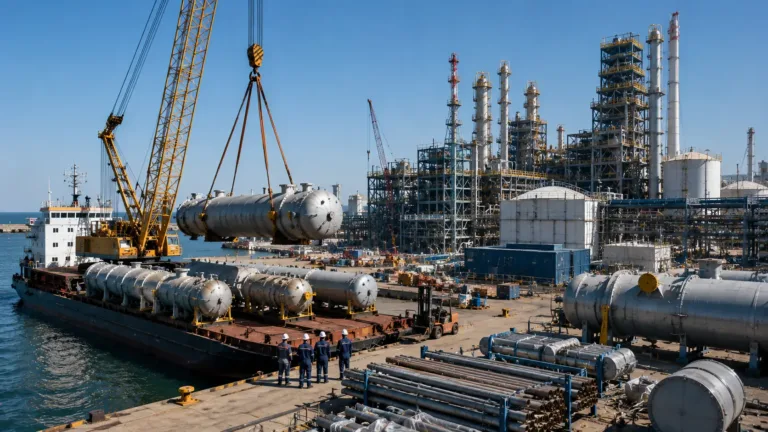
On June 19, nine key units for the plant’s pyrolysis facility arrived at Yersai Port on the Caspian Sea. The reactors, separators, and distillation columns were delivered from China on schedule. KazMunayGas confirmed that the equipment is now being prepared for transport to the special economic zone in the Atyrau Region, where the complex is under construction.
The Silleno complex will have an annual production capacity of 1.25 million tonnes of polyethylene, equivalent to roughly 1% of global output. Commercial operations are scheduled to begin in 2029. At the same time, Air Liquide announced plans to build two nitrogen production units worth €70 million, dedicated exclusively to serving the new facility. Overall, Kazakhstan currently has 30 chemical industry projects under active development.
Feedstock for the complex will come from the Tengiz field. Up to 1.6 million tonnes of ethane will be extracted annually from associated gas, along with significant volumes of propane and butane. Kazakhstan’s Ministry of Energy has made its priorities clear: domestic petrochemical plants and municipal consumers will receive feedstock first, while exports will take second place. Dry gas remaining after processing will be directed toward expanding gasification across Kazakhstan rather than being exported. The country is deliberately reducing pipeline gas exports in favor of domestic value-added industries.
Just a few years ago, Kazakhstan was a major exporter of liquefied petroleum gas (LPG) to Europe, Algeria, and Türkiye. Over the past five years, however, LPG exports have steadily declined, with monthly shipments at times falling by more than 32%.
The launch of Silleno has the potential to reshape Eurasian supply chains. China and Southeast Asia are expected to become the primary export markets for the plant’s polyethylene. Kazakhstan’s proximity to China provides a significant logistical advantage, allowing polymers to be transported overland instead of relying on congested and increasingly vulnerable maritime shipping routes. This will strengthen competition with major petrochemical producers in the United States and the Middle East.
For Russia, the project presents both challenges and opportunities. On one hand, the Silleno complex will fully satisfy Kazakhstan’s domestic demand, replacing imports from Russian suppliers. Additional production within the Eurasian Economic Union (EAEU) is likely to increase competition and put downward pressure on regional polymer prices. On the other hand, Russia’s petrochemical company SIBUR owns a 25% stake in the project, making it a strategic partner rather than an outside observer. Under current sanctions, joint ventures such as Silleno provide opportunities to develop catalysts, additives, and industrial equipment sourced from friendly countries, helping establish a technology cluster that is less dependent on Western suppliers.
Kazakhstan is transforming its natural gas resources into a high-value polymer industry. The Silleno complex will not only meet domestic demand but also position the country as a significant supplier of finished petrochemical products to global markets.
Source: CDU TEK
Image: AI-generated