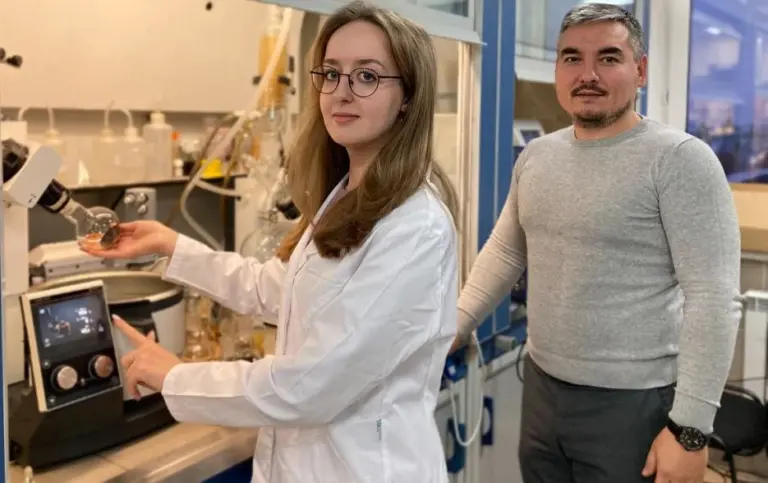
Kazan Federal University has developed and tested a technology that allows improving the properties of heavy oil directly in the reservoir. The method reduces the viscosity of raw materials, reduces the sulfur content and increases the return of deposits, making production more efficient and cost-effective.
The development belongs to specialists from the Institute of Geology and Oil and Gas Technologies of Kazan Federal University. It is based on the use of sodium metal nanoparticles, which are introduced into the formation and trigger a chain of thermal and chemical reactions. The technology has already passed pilot tests at oil facilities in Tatarstan.
The operating principle is based on the fact that stabilized metallic sodium, entering the formation, interacts with formation water. During the reaction, heat and active hydrogen are released. It warms up locally oil and at the same time changes its chemical composition. As a result, heavy oil becomes less viscous, moves more easily through the rock, and is easier to extract to the surface.
To evaluate the effectiveness of the approach, a series of laboratory experiments were conducted at KFU. Conditions close to real reservoir conditions were simulated: temperatures from 150 to 300 degrees and high pressure. Heavy oil from the Ashalchinskoye field was used as samples. The researchers monitored changes in the physical properties, composition, and gas products of the reaction.
The most pronounced effect was obtained at a temperature of about 250 degrees. Under these conditions, the viscosity of oil decreased by about a quarter, and the proportion of sulfur compounds decreased by almost 18%. In addition, during the reaction, acidic gases – primarily hydrogen sulfide and carbon dioxide – were completely bound. This reduces the likelihood of equipment corrosion and increases the stability of the field infrastructure.
According to the developers, the active interaction of sodium with sulfur components makes the technology especially promising for fields with heavy and high-sulfur oils, where the preparation of raw materials usually requires high costs.
Practical tests carried out in 2024–2025 at the facilities of PJSC Tatneft confirmed the efficiency of the method. KFU believes that new technology can become an effective tool for increasing oil recovery, improving the quality of heavy oil and reducing the costs of its production and preparation.
Source of information and photo: Ministry of Education and Science of Russia