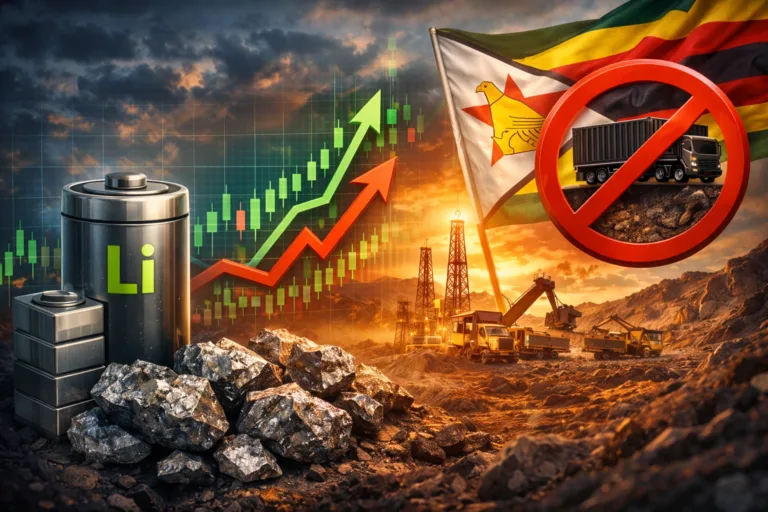
World prices for lithium and shares of mining companies have risen sharply. The reason is the decision of the authorities of Zimbabwe, one of the leaders in the extraction of this raw material, to suspend the export of concentrate. Market participants were worried that supplies of strategic metal for batteries will be reduced.
Futures prices for lithium carbonate on the Guangzhou Futures Exchange jumped by more than 5%, reaching 177 thousand yuan per ton. Stock indices followed the prices: securities of lithium producers from China, Australia and America showed strong growth.
Zimbabwe has banned the export of lithium concentrate abroad since December 4. The country’s Minister of Mining and Mining Polit Kambamura explained that this measure is aimed at developing domestic processing and suppressing illegal supplies. Export permits will now only be received by those companies that have an official production license and the required processing capacity.
Experts draw parallels with a similar move by the Democratic Republic of Congo, which last year introduced a ban on the export of cobalt. According to Cameron Hughes from the consulting company CRU Group, the tightening of rules in Zimbabwe is due to both rising lithium prices and the need to combat illegal trafficking of raw materials.
The country’s government has taken a course to combat the illegal trade in minerals and stimulate the creation of industries with high added value. Chinese companies Zhejiang Huayou Cobalt and Sinomine Resource Group are already implementing lithium deep processing projects in Zimbabwe.
Since November, prices for this metal have almost doubled. The reason is explosive demand from manufacturers of energy storage systems. Uncertainty over supplies from one of the key regions added nervousness to the market, returning quotes to 2023 levels.
Jefferies analysts believe Zimbabwe’s decision will lead to a temporary shortage of raw materials. Although the market expected increased control over production, such a tough step came as a surprise to many.
This situation is part of a global trend: countries rich in resources are seeking to obtain more benefits from their processing, which inevitably creates turbulence in world markets. Previously, similar measures were introduced by Indonesia (for nickel and coal) and Congo (for cobalt).
For China, which is the largest consumer of lithium, ban is of particular importance: last year, almost 20% of all imported concentrate came from Zimbabwe. The market reacted: shares of Tianqi Lithium in Hong Kong rose by more than 7%, Ganfeng Lithium by almost 6%. In Australia, shares of PLS Group rose almost 8%, and Mineral Resources – by 6%. American Sigma Lithium and Albemarle closed trading with gains of 13% and 10%, respectively.
Thus, Zimbabwe’s decision has already caused a chain reaction in the global lithium market. Investors and producers will now have to assess how long-term the ban will be and how it will impact global supply chains for the metal critical to the energy transition.
Source: MINING.COM