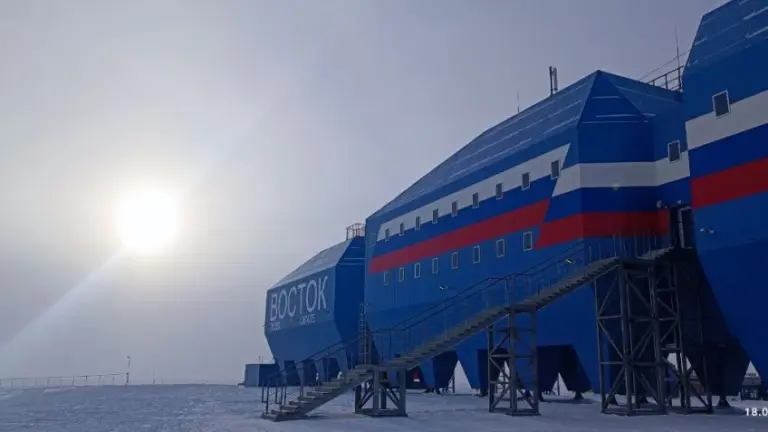
St. Petersburg Mining University is preparing to reveal the secrets of the bottom of Lake Vostok in Antarctica. Unique technology developed by scientists university, allows you to safely obtain samples of bottom sediments that have been isolated from the outside world for millions of years.
Lake Vostok is hidden under four kilometers of Antarctic ice. Its bottom sedimentary rocks store information dating back more than 30 million years. Studying these samples may provide answers to fundamental questions geology, ecology and biology. Scientists hope to discover traces of ancient life and unique microorganisms adapted to extreme conditions.
The patented sampling technology guarantees complete environmental friendliness. This is a key requirement for working in Antarctica. The process begins with drilling a well. To protect against colossal pressure, a special safe liquid is poured into it. After pumping out part of the liquid, water from the lake itself rises into the well.
Then the sealed module is lowered to a depth. It equalizes the pressure and releases a research apparatus that takes soil samples. All manipulations occur under sterile conditions, and samples are stored at natural temperature and pressure, which is critical for the accuracy of future analyzes.
The work is being carried out within the framework of the strategy for the development of Russian activities in Antarctica until 2030. Scientists at the Mining University have already successfully tested a new environmentally friendly drilling fluid that meets strict international standards. The next step will be the creation of an experimental sample of equipment and its testing on the ice continent.
The main difficulty remains obtaining international approval. Consent procedures in Antarctica, which is governed by a 54-nation treaty, traditionally take a long time. However, Russian science has created all the necessary groundwork for future research.
In the coming years, the world may witness a real scientific sensation. Russian researchers are one step away from touching an unknown ecosystem that has developed in complete isolation for millions of years. The success of this mission will open a new chapter in the study of our planet.
The material was prepared with the support of the Russian Ministry of Education and Science as part of the Decade of Science and Technology.
Source: forpost-sz.ru