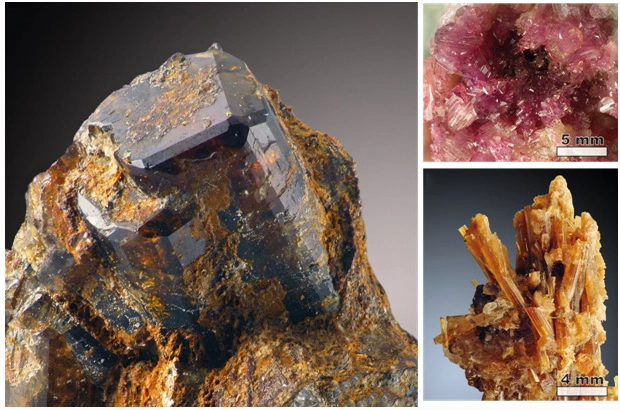
The Springer Mineralogy series has published a book summarizing many years of research into one of the most complex groups of natural compounds – Vesuvian family minerals. The authors were representatives of two academic institutions: Taras Panikorovsky from the Kola Science Center of the Russian Academy of Sciences and Nikita Chukanov from the Institute of Problems of Chemical Physics of the Russian Academy of Sciences. The work lasted 13 years and included field expeditions, museum research and tens of thousands of laboratory experiments.
The object of study was island calcium and aluminum silicates. These minerals are distinguished by their complex crystal structure and varied chemical composition. To understand their nature, scientists performed more than four thousand analyzes using X-ray diffraction, spectroscopy and thermal methods. Specimens from museums in Russia and Europe, as well as materials collected in Karelia, the Kola Peninsula and other well-known deposits, were introduced into scientific circulation.
Geography field work impressive. The researchers visited the Vesuvius volcano, from where the group got its name, the Mineralogical Museum of Naples, the Lupicco mine in Karelia and the Sakharjok massif on the Kola Peninsula. The collection was replenished with two hundred new specimens. Painstaking work in the funds of St. Petersburg, Moscow, Miass and Apatity made it possible to collect unique comparative material.
The monograph describes in detail how the minerals of the vesuvian group are structured, under what conditions they are born and how they change under the influence of temperature and pressure. It turned out that their structure is sensitive to the external environment. This property makes them natural sensors of geological processes. Based on the composition and characteristics of the crystal lattice, one can now judge the temperature and pressure at which rocks were formed.
The authors went beyond basic science and showed how to use this knowledge in practice. They proposed a technique for quickly estimating crystallization temperatures using infrared spectroscopy. This opens the way to the use of vesuvian as a geothermometer. Such tools are especially in demand for geological exploration in hard-to-reach areas, including the Arctic, where traditional methods often fail.
The study also brought nomenclatural results. Several new mineral species identified during the work have already received official recognition from the International Mineralogical Association. This clarifies the overall picture of the classification and helps systematize knowledge about the group.
A special section is devoted to applied perspectives. Due to their high stability and ability to retain various elements in their structure, vesuvian minerals are considered candidates for creating materials that isolate hazardous waste. We are talking, among other things, about radioactive burials, where reliable fixation of radionuclides for geological periods is required.
The publication of a book in one of the world’s leading scientific publishing houses confirms the high level Russian mineralogical school. Despite the difficult international situation, the research of our scientists remains in demand and fits into the global context of modern crystal chemistry and Earth sciences.
Source: Ministry of Education and Science of Russia
Image: Ministry of Education and Science of Russia