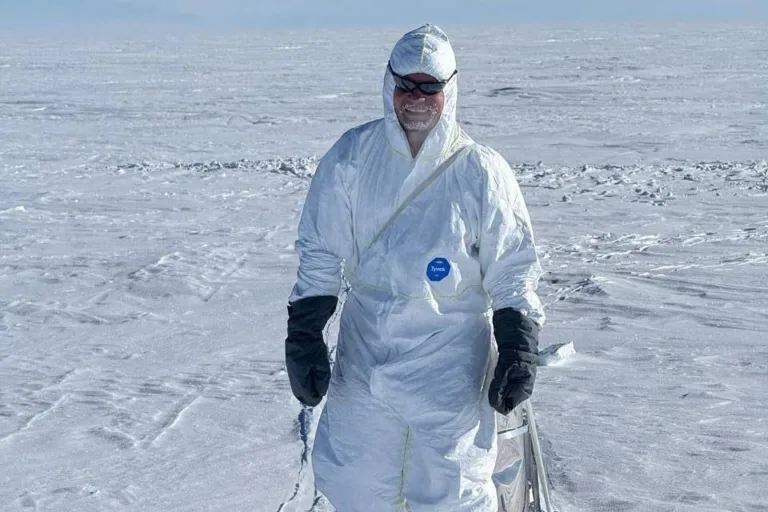
Vostok Station in Antarctica has become an ideal platform for hunting for particles of extraterrestrial matter. There is practically no industry or local population here, and the snow and air are considered standard clean. Thanks to this, scientists of the Russian Antarctic Expedition can find micrometeorites with record efficiency.
In areas with high technogenic load, the ratio of cosmic and terrestrial dust is approximately one to a million. In East Antarctica, this figure is much better – one cosmic particle per thousand to ten thousand terrestrial ones. Such purity opens up unique opportunities for research.
The search method is simple, but requires pinpoint precision. Researchers go outside the station to collect samples of newly fallen snow. Then it is melted and passed through special filters. In the resulting samples, they look for microspherules – tiny shiny balls. When a meteoroid enters the atmosphere, it melts due to friction and takes on a round shape. After the discovery, chemical and isotopic analysis follows, which confirms or refutes the cosmic origin.
Studying micrometeorites helps answer fundamental questions. Scientists are obtaining data about how the solar system was formed. Particles may contain traces of organic compounds, which is important for astrobiology. In addition, the researchers are assessing how the constant flow of extraterrestrial matter affects atmospheric processes and climate.
Every day, about a hundred tons of material from space falls to Earth. These are asteroid fragments, comet particles and micrometeorites. Even the largest of them rarely exceed 60 microns in diameter. Small fractions can linger in the upper layers of the atmosphere for hundreds of days, gradually settling to the surface.
Despite the impressive daily figure, the contribution of this substance to the mass of the planet is negligible. Even over a billion years of continuous fall, cosmic dust would increase the weight of the Earth by only one part in a billion. But for science, each such microscopic guest is priceless – it carries information about worlds that disappeared long before the appearance of humanity.
Source: @aari_official
Image: AARI