Researchers from Osaka Metropolitan University have found that official data on methane emissions in Japanese cities does not take into account many small sources. We are talking about restaurants, shops and private homes. In total they give a significant gas volume, which affects the climate more than previously thought.
Methane is one of the most corrosive greenhouse gases. Its global warming potential is about 80 times higher than carbon dioxide. The Japanese authorities are actively fighting major polluters – factories and chemical production. But as a new study shows, the problem may be in the details.
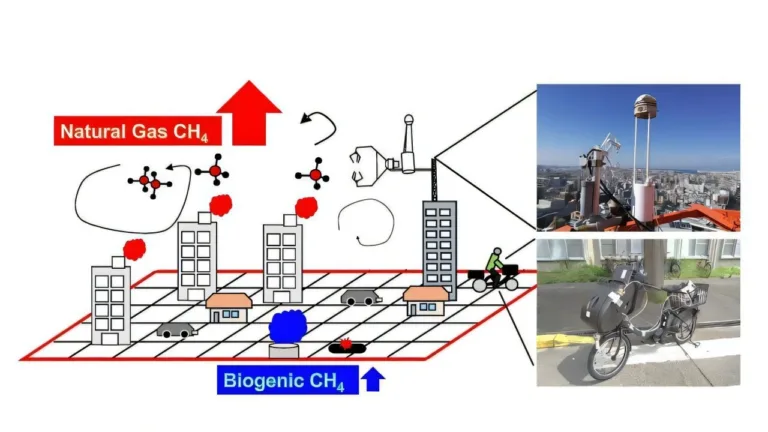
Scientists led by Associate Professor Masahito Ueyama used an unusual technique. They installed sensors on a tall tower in the city center to continuously monitor the air. And for ground measurements we used a bicycle with portable equipment. This approach allowed us to obtain a continuous picture of emissions, rather than one-time samples.
When the researchers compared their data with official reports, the difference was huge. In addition to well-known industrial giants, the system recorded mass of unaccounted emissions. Sources were found in the most unexpected places: in sewer systems, in restaurant kitchens, and even in the process of preparing traditional Japanese products such as fermented sauces.
The analysis showed that emissions are noticeably higher on weekdays and are clearly divided into daytime and nighttime. Along with methane, the instruments detected ethane, a gas that clearly indicates human activity. This means that the main culprit is not nature, but urban infrastructure and everyday life.
Particularly interesting was the presence of biogenic methane. It is produced by microorganisms in wastewater and during fermentation of foods. Such sources were also not taken into account before, although they are widespread.
The authors of the study are confident that their method makes it possible to track in real time exactly where the gas is coming from – from fossil fuels or from biological processes. This is a key difference for developing control measures. Leaks from gas networks can be eliminated by repair, but sewage and fermentation will have to be dealt with differently.
Professor Ueyama hopes other cities will adopt their approach. The system will help not only find hidden sources, but also evaluate how effectively emission reduction programs are working. This means it will become easier to combat climate change.
Source: Phys.org
Image: Osaka Metropolitan University