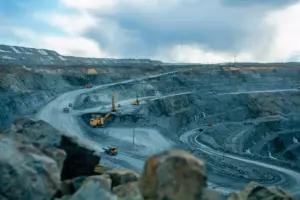
Russian researchers have developed and tested an effective combined technology for the development of complex gold deposits. This method solves the key problem of the industry – the low percentage of extraction of precious metal from heterogeneous ores.
Specialists from the South Russian State Polytechnic university conducted a large-scale comparison of three mining methods: continuous, selective and combined. The work was carried out at the Gross, Tokko and Tabornoe deposits, where gold is unevenly deposited, which has always created difficulties for the industry.
Continuous mining of ore showed high speed, but led to strong mixing of high-grade and low-grade rock, which sharply reduced the final gold yield. The selective method, although it provided maximum metal recovery, proved to be prohibitively expensive and slow due to the need for constant geological analysis.
The best results were shown by the combined technology. It combines the advantages of the other two approaches. The essence of the method is to group ore sections with similar properties into single blocks for processing. This made it possible to significantly reduce dilution without losing speed of work.
The economic effect of introducing combined technology is impressive. The net profit when using it reaches 4218 rubles for each ton of processed ore. More importantly, the recovery rate gold rose to a record 85.2%.
Scientists have prepared practical recommendations for companies. The choice of method depends on specific conditions: selective mining is suitable for rich gold-antimony ores, and continuous mining is suitable for homogeneous ores. However, for most complex fields, a combined approach will be the most cost-effective solution.
The introduction of this development is extremely important for Russia. In recent years, the overall percentage of gold extraction in the country has decreased by 8.2%. The new technology is ready for practical use and will help the gold mining industry increase profitability and significantly reduce losses of valuable metal.
The material was prepared with the support of the Russian Ministry of Education and Science as part of the Decade of Science and Technology.
Source: @zolteh