Two of Russia’s industrial giants are investing in talent development from the earliest stages of education. Tatneft has built a lifelong educational ecosystem, while Metalloinvest has launched the country’s first academic program dedicated to green metallurgy. Kindergartens, schools, colleges, universities, and production facilities are being connected into a single pipeline for training future engineers.
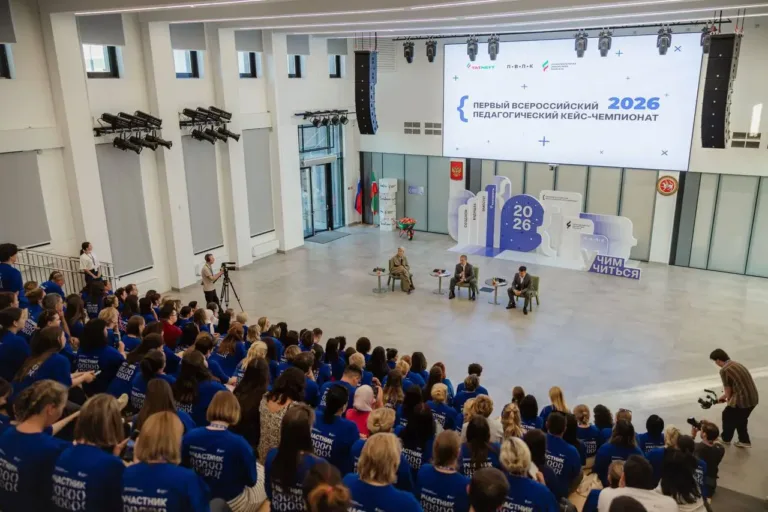
Speaking at the Third All-Russian Educational Case Championship, Tatneft CEO Nail Maganov outlined the principle behind the company’s educational model: trust must be earned through hard work and integrity. According to him, this straightforward approach has consistently delivered results. Olga Tsygina, head of Tatneft’s Corporate University, added that a teacher’s primary mission is not simply to transfer knowledge, but to reveal the beauty of a subject and help students discover their own path.
That philosophy is backed by a substantial educational infrastructure. Tatneft has established a comprehensive system that supports learning from early childhood through professional development. The network includes 12 kindergartens, eight schools, five technical colleges, six universities, and 17 continuing education institutions. The company finances new construction and renovations, equips classrooms, and helps design academic programs. Students from 56 educational institutions complete internships at Tatneft’s production facilities.
The company also organizes youth initiatives such as the open TatneftTechCupChallenge case competition and the International Oil and Gas Forum. Meanwhile, Tatneft’s Corporate University serves as the primary center for employee training and professional development.
Metalloinvest is pursuing a similar strategy. Together with the National University of Science and Technology MISIS (NUST MISIS), the company has launched Green Metallurgy—Russia’s first educational program focused entirely on direct reduced iron (DRI) technologies and the transition to hydrogen-based steelmaking. First-year students have already begun paid internships at the Lebedinsky Mining and Processing Plant and the Oskol Electrometallurgical Plant.
Last year, the partners also introduced five educational tracks in low-carbon ironmaking in Moscow and at MISIS campuses in Stary Oskol and Gubkin. At the same time, they launched a master’s program titled Production of Metallized Raw Materials, which has no equivalent in Russia. Students do more than attend lectures—they solve real industrial challenges. For the third consecutive year, the Lebedinsky Mining and Processing Plant has formed educational and production teams in which students work alongside engineers to tackle practical operational issues.
Industrial companies are no longer waiting for qualified specialists to appear at the factory gates. Instead, they are building their own educational ecosystems, where future engineers begin their journey in school, gain hands-on experience in production facilities, and return after graduation as highly skilled professionals.
Source: @gorprom
Image: Tatneft