You choose geophysics for a project – and you are advised to “take electrical prospecting”. But what can she do? What problems does electrical prospecting actually solve in geology? Where will the method work, and where will you just waste your money? Maria Kostina, a geophysicist with 15 years of experience in exploration geophysics, answers these questions – what is electrical prospecting, what environmental parameters does it measure (resistivity, polarizability), and what electrical prospecting methods are used on real objects to search for minerals.
What is electrical prospecting
Electrical prospecting is one of the geophysical methods that studies the electrical properties of rocks, such as resistivity and polarizability (the ability of a rock to accumulate an electrical charge when exposed to external influences). Geophysicists measure how natural electric fields, arising in the thickness of the Earth, and the fields that they artificially generate, and based on the results of processing, anomalies are identified – areas where the response differs from the background.
For such an anomaly to appear, the search object must differ in electrical properties from the host rocks. These can be either the ore bodies themselves (for example, massive or disseminated sulfides), or ore control structures: faults, zones of metasomatism, contacts with intrusive bodies.
Read more about electrical prospecting methods – their varieties, principles and applications – in the article: Geophysical methods of field exploration
Now let’s look at exactly what geological problems can be solved using electrical prospecting.
What problems does electrical prospecting solve in geology?
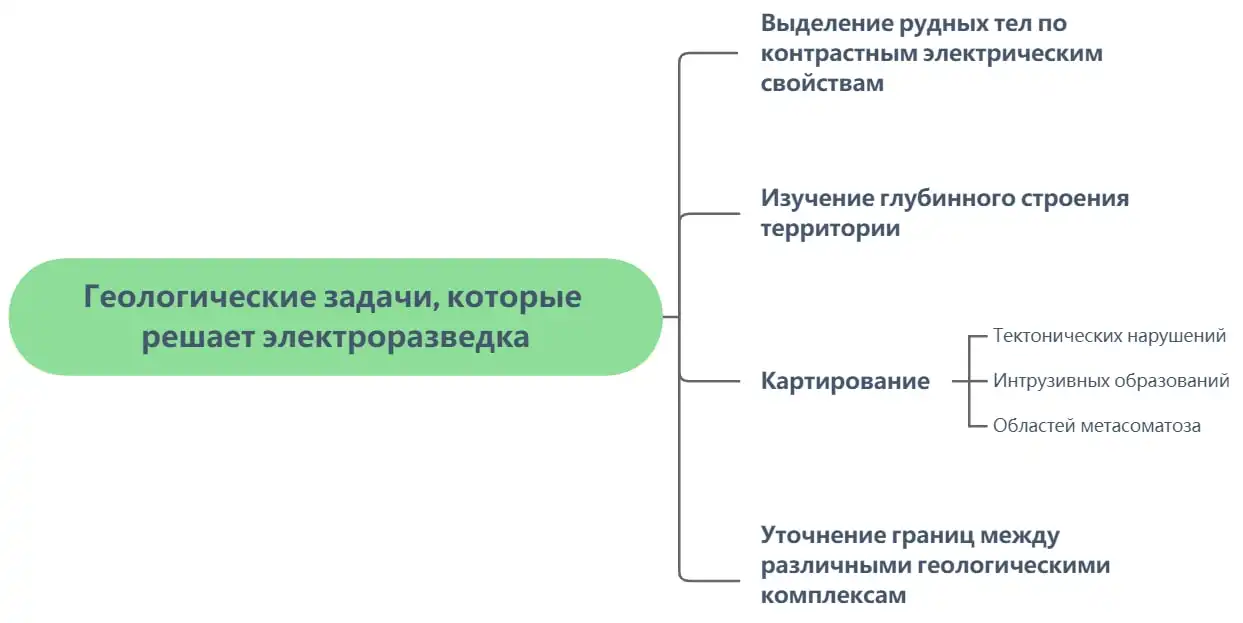
Electrical prospecting is used both for direct detection of ore bodies and for identifying indirect ore-controlling signs.
Direct detection is possible if certain conditions are met:
– shallow depth;
– contrast in electrical properties between the ore and the host rock.
If such conditions are absent, and the geological structure is complex, electrical prospecting is used to search for structures with which ore deposition is associated – faults, intrusions, zones of metasomatism, contacts, etc.
Deep structure
Electrical prospecting helps to identify deep supply channels through which hydrothermal solutions flowed. On the section they are displayed as anomalies of low resistance, leading deeper. This helps the geologist understand the overall structure of the ore-bearing system and build a genetic model of the deposit.
Tectonic disturbances
If ore bodies are confined to faults, electrical prospecting makes it possible to map zones of tectonic disturbances. Such zones, as a rule, are represented by clastic rocks with clay filler – they have low resistivity and are clearly distinguished in plan as extended linear anomalies.
Intrusive formations
When mineralization is confined to contact with an intrusive body (for example, a granite stock), electrical prospecting can help locate the intrusive body. It will appear as an area with increased resistance values.
Metasomatism zones
Rocks that have undergone metasomatic changes (propylitization, beresitization, silicification) change their electrical properties.
- Zones of propylitization and beresitization will appear as areas of reduced resistance.
- Silicified zones, on the contrary, will be characterized by high resistivity values.
Boundaries of geological complexes
Electrical prospecting can help clarify the boundaries between different complexes if they differ in electrical properties. This is especially important if mineralization is known to be associated with only one of the complexes.
Electrical prospecting solves both direct and indirect geological problems – the main thing is that the method is selected for the properties of the object and the geological situation. Below is an example of how this works in practice.
Case: how nickel deposits are found using airborne electromagnetic prospecting methods
Nickel deposits are typically massive sulfide ores. They conduct current well due to the formation of electronic bonds, therefore they appear in geophysical fields as conducting objects.
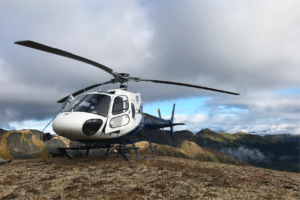
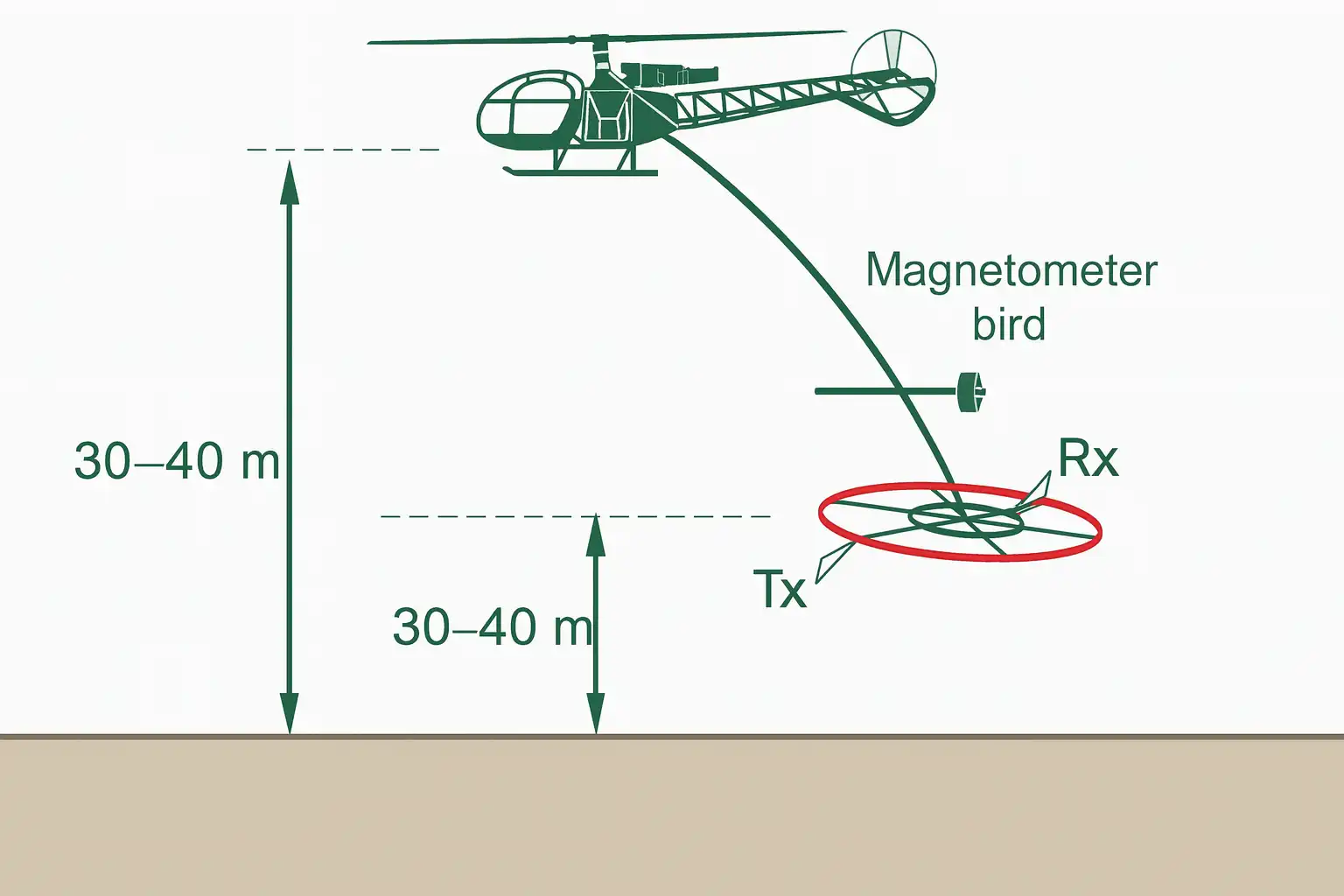
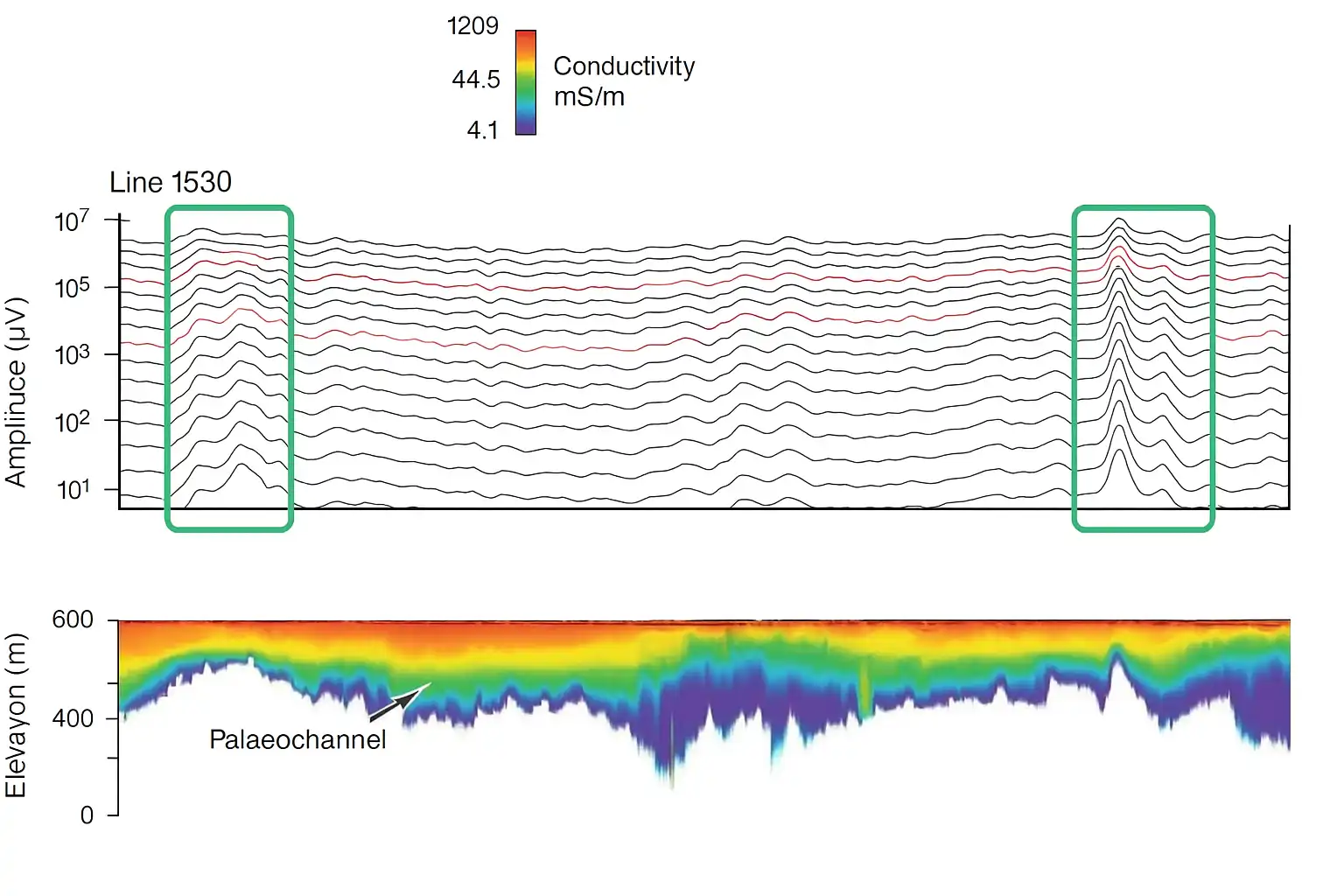
One of the projects used aerial EM research in a helicopter version. On board there is a generator loop that transmits current with a pause, and a receiver that measures the response from underground conductive objects during the pause. Also, during the same pause, the magnetic field is recorded using a magnetometer.
If there is a highly conductive orebody beneath the surface, it will appear on the map as an anomaly – an area with elevated conductivity values. Thus, geophysicists can localize sulfide bodies even if they occur at great depth.
Do you want to see the ore body in volume? Using probing, you can obtain a spatial model of an object – highlight its shape, depth, extent and orientation. Read more in our article about the 3D electrical tomography technique: how to “see” an ore body in 3D.
So – what is electrical prospecting and why is it needed in geophysics?
Electrical prospecting is, of course, not a universal tool. This is one of the methods that only works when the properties of the object are understood and geological setting. It helps to find ore bodies not only directly (if there is a contrast in electrophysics), but also to identify ore-controlling structures – faults, metasomatism zones, contacts with intrusive bodies. The main thing is that a geologist and a geophysicist work together on a problem: from the geologist – the formulation of the problem, from the geophysicist – the selection of a method that will solve it.
What problems did you have to solve using electrical prospecting? Tell us about your experience in the comments – especially if there were difficult cases or non-standard solutions. It will be interesting and useful for us and our readers.