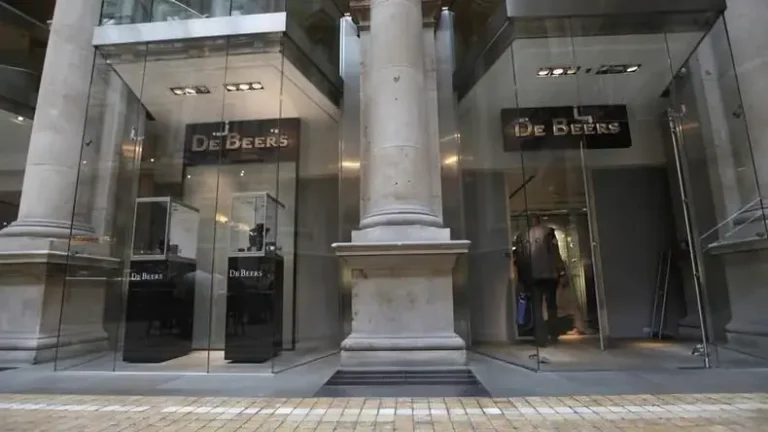
Botswana is seeking to increase its stake in De Beers while Anglo American looks for a buyer for its 85%. However, Moody’s has downgraded the country’s credit rating to Baa2, explicitly warning that if the expanded stake is financed with debt, the rating could be cut again. The country must choose between strengthening control over the diamond industry and increasing its debt burden.
Anglo American intends to sell its stake in De Beers, while Botswana holds the remaining 15%. In July, a government representative told Reuters that Anglo had identified a preferred buyer, and Botswana is now deciding whether to exercise its right of first refusal alone, together with that buyer, or with an additional partner. A final deal has not yet been announced.
For Botswana, this is not simply about buying shares. De Beers operates in several diamond-producing countries and for decades has provided about a third of the republic’s budget revenue and three-quarters of its foreign currency receipts. A larger stake would give Gaborone more influence over the company’s direction at a moment of ownership change. But it would also mean additional government spending in an industry that is in decline and already weighing on the budget.
Vice President and Finance Minister Ndaba Gaolathe outlined both sides of the dilemma. In an interview with Bloomberg, he said the final stake would exceed 15% in any case, but stressed that the country can no longer afford investments without regard to their cost. The government has voiced its ambitions, but has not publicly specified the size or financing structure of the additional stake.
The paradox is that rising output doesn’t guarantee rising revenue. In the first half of 2026, production in Botswana grew 43% to 10.3 million carats. Meanwhile, De Beers’ group revenue fell from $2 billion to $1.6 billion, and the average realized price of rough diamonds dropped 32% to $105 per carat. These figures reflect different parts of the business, but together they explain why a recovery in production alone doesn’t solve the country’s budget problems.
De Beers reported an EBITDA loss of $113 million for the half-year. That is better than last year’s $189 million loss, but the company remains under pressure: small and low-quality natural stones are losing out to synthetics, and demand in mainland China remains weak.
Botswana has gained some breathing room. The budget deficit for the year to March 2027 was revised from 26.35 billion pula (8.9% of GDP) to 9.26 billion (3.1%). The improvement stems from a large transfer from the central bank and spending savings. However, Gaolathe warned that this does not remove structural fiscal pressures. An improved forecast for a single year does not by itself say how much the country can safely borrow for a long-term investment.
Moody’s is not the first to point to concentration risk. In its 2025 assessment, the International Monetary Fund cautioned against increasing the stake in De Beers given the fiscal position and dependence on diamonds. The warning came before the current downgrade, but it records the same problem: the purchase increases the country’s exposure to the diamond sector precisely when weak revenues limit its ability to pay.
The outcome now depends on three parameters: how much exactly Botswana will acquire, at what price, and who will finance the deal. Bringing in partners would ease the burden on the treasury but would determine how much additional influence is gained. If the bet is placed on heavy borrowing, the country will move closer to the scenario Moody’s explicitly flagged as risky.
Source: Reuters
Image: REUTERS/Andrew Winning