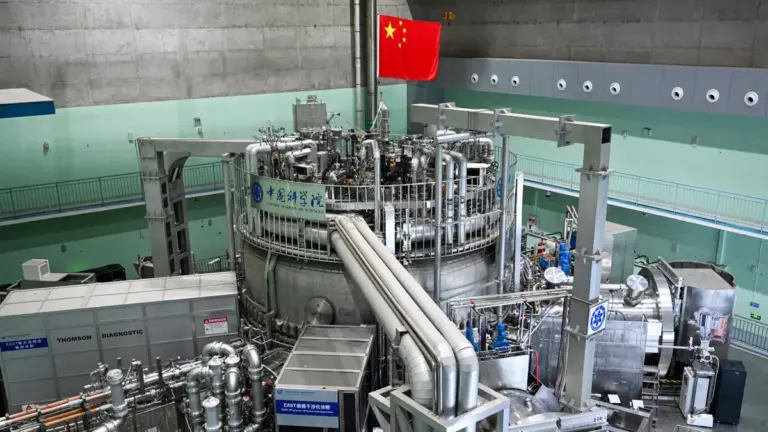
China’s EAST fusion reactor, known as an artificial sun, has managed to stably contain plasma at extremely high densities. Scientists believe that this is one of the most important steps towards creating a practically inexhaustible and environmentally friendly energy source.
The achievement was reported by researchers from the Chinese Academy of Sciences. The experimental advanced superconducting tokamak EAST was for the first time able to maintain a stable plasma state at densities significantly exceeding the so-called Greenwald limit. Previously, it was believed that beyond this boundary the plasma becomes unstable and the thermonuclear fusion reaction becomes impossible to control.
Thermonuclear fusion is considered as a potential basis for the energy of the future. Unlike traditional nuclear power plants, it does not produce long-lived radioactive waste and is not associated with greenhouse gas emissions. However, the technology has remained experimental for decades: existing installations still waste more energy than they produce.
The EAST reactor is a type of tokamak – installations in which hot plasma is held by powerful magnetic fields in a torus-shaped chamber. The main task of such reactors is to create conditions under which the nuclei of light elements begin to fuse, releasing energy, as happens in the depths of the Sun.
One of the key limitations was the density of the plasma. The higher it is, the easier it is to start a reaction, but the more difficult it is to maintain stability. Chinese scientists managed to find an operating mode in which the plasma remained stable even when exceeding the previous limit by 1.3–1.65 times. This was achieved by fine-tuning the fuel supply and microwave heating, as well as controlling the interaction of the plasma with the chamber walls.
Of particular value is the fact that during the experiment it was possible to approach a regime that theoretically allows for an increase in density without loss of stability. This opens up new possibilities for the design of future fusion reactors.
The results obtained at EAST will be used in the development international projects, including the world’s largest experimental reactor, ITER, under construction in France. Although the advent of commercial fusion power plants is still a long way off, the new achievement shows that controlled fusion technologies are gradually moving from theory to practice and can play a key role in the energy sector in the second half of the 21st century.
Source: Live Science
Photo: Zhang Dagang