Archaeologists from the National Museum of Natural History of Chile have determined that a mummy found next to an ancient turquoise mine in the north of the country belongs to a miner who died as a result of accident in production.
The remains were discovered back in the 1970s near a pre-Hispanic mine in the center of the Atacama Desert. Funerary items were found next to the body, including a bow and arrows and a set for preparing hallucinogenic substances. For a long time, scientists noted only a broken leg, but a full-fledged study was carried out only in 2023 using computed tomography and radiography.
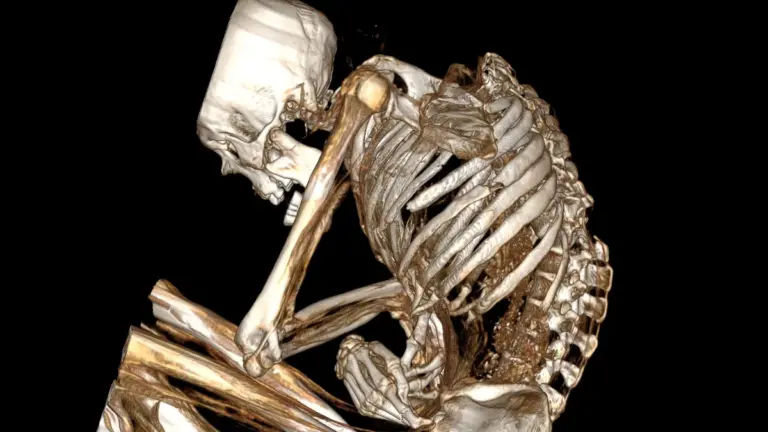
The scan showed multiple unhealed fractures of the spine, ribs, scapula and collarbone. According to the researchers, the nature of the injuries indicates a powerful blow to the upper back. The chest was partially destroyed and the vertebrae were displaced. A fracture was also found in the lower part of the spine.
Scientists have determined that the man died between the ages of 25 and 40. Radiocarbon dating dated the find to between 894 and 1016 AD. This time refers to the transitional stage in the history of the Andes between the decline of the Huari culture and the rise of the Inca civilization.
The absence of head and arm injuries suggested that the person was in an inclined position at the moment of impact – possibly mined stone or tried to take cover from falling debris. Such injuries are typical for victims of mine collapses and other severe industrial accidents.
Turquoise mining in the Atacama Desert has been going on for almost two thousand years. These were usually shallow open pits where workers used stone hammers and simple tools. However, the mine next to which there was discovered deceased, was distinguished by the presence of underground passages, which significantly increased the risk of collapses.
The study provides the first direct evidence that ancient miners in Chile died as a result of industrial accidents. The find helps to better understand the working conditions and risks faced by miners more than a thousand years ago.
Source: Live Science
Photo: Francisco Garrido and Catalina Morales