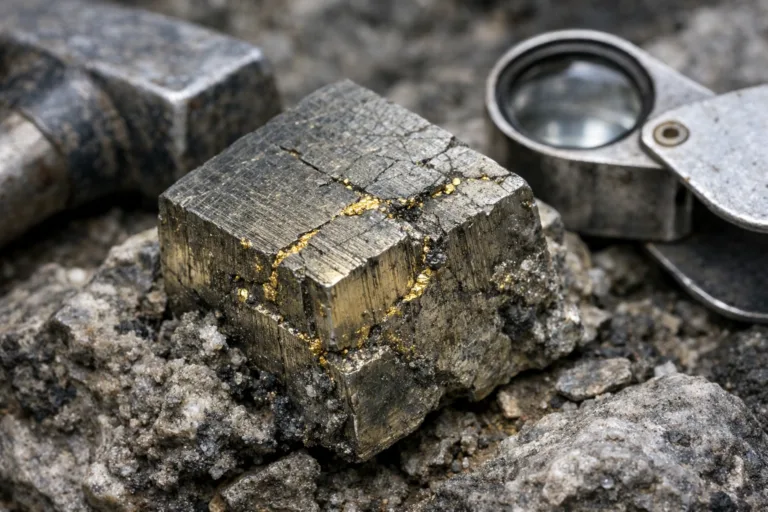
An international team of researchers led by Professor Xiao Wenjiao explained the key mechanism behind the formation of one of the world’s largest gold-bearing areas — Tien Shan belt in China. The discovery is of great importance for geological exploration.
The Tien Shan orogenic belt is the second richest gold region on the planet. However, the origin and process of metal concentration in deposits such as the giant Savayaerdun have long remained a mystery to scientists.
Researchers from the Xinjiang Institute of Ecology and Geography studied the geology of the area in detail, using modern methods to analyze microscopic changes in elements and isotopes gold minerals. Their work showed that a two-step process was critical.
At the first stage, the early enrichment of the mineral pyrite in dark rocks with gold occurred. This initial concentration set the stage for the future deposit.
Then, in the second stage, the phase separation of fluids carrying gold occurred, a process similar to the separation of oil and water. It was this phenomenon that led to a sharp concentration of the precious metal and the formation of industrial reserves.
The findings provide scientists and geologists with critical guidance to search for new deposits not only in the Tien Shan, but also in other geological regions of the world. The study moves the process of gold formation from a mystery to a realm of understandable mechanisms.
Source: phys.org
Image generated by a neural network