A team of scientists from the Russian Academy of Sciences has identified new promising areas for searching gold in hard-to-reach areas of Eastern Yakutia. This discovery was made possible through the use of advanced remote sensing methods.
Eastern Yakutia has long been considered one of the richest regions for gold deposits, including large and super-large deposits. However, the northwestern part of the territory has been studied extremely poorly due to its inaccessibility, which makes traditional field research complex and expensive.
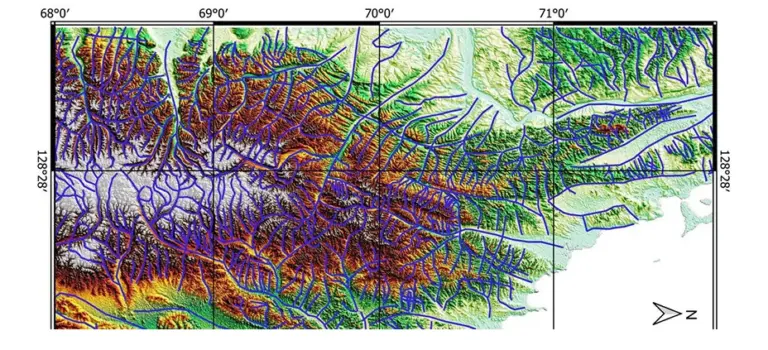
Most of the gold deposits in this region are of hydrothermal origin. They are formed when hot mineralized solutions rise from the earth’s interior and deposit gold-bearing ore in cracks in rocks. A key role in this process is played by deep faults, which serve as natural conductors for these solutions. Therefore, studying the network of faults helps to predict with high accuracy the places where gold may be located.
To analyze the structure of faults, scientists used a complex of modern methods. They applied Earth remote sensing data, tectonophysical reconstructions, as well as GIS and neural networks. This integrated approach made it possible to conduct a detailed analysis without large-scale field work. As a result, the researchers were able to identify tectonic structures that were most active in the past and which are most likely associated with gold deposits.
This research is of great practical importance for the development of the mineral resource base of the Republic of Sakha (Yakutia). Identification of promising areas allows for targeted planning of geological exploration work, optimizing costs and increasing the efficiency of searching for new gold deposits.
The material was prepared with the support of the Russian Ministry of Education and Science as part of the Decade of Science and Technology.
Source: minobrnauki.gov.ru